The Consistency Protocol:
Turning Social Chaos into Brand Infrastructure
The Problem:
The Hidden Cost of "Improvised" Marketing
Picture your production floor. It operates on precision, schedules, and strict tolerances. Now, look at your company's social media feed. If it looks like a collection of scattered ideas, inconsistent formats, and shifting tones, you have an operational problem.
For many heavy industrial OEMs and B2B leaders, social feeds are chaotic—not just for the viewer, but for the internal teams running them. When the visual tone changes depending on who had twenty minutes to spare that day, the result isn’t just inefficiency; it is incoherence.
In the high-stakes world of industrial sales, incoherence creates friction. It kills brand recognition faster than a failed product launch.
The Core Objective: Standardization
Your brand becomes a recognizable asset only when it communicates consistently across formats, channels, and time. Reliability is the currency of the industrial sector. Your digital presence shouldn't be "improvisational theater"; it should be a compounding channel for recognition where the market knows exactly who is speaking before they even read the caption.

Why Organization is a Competitive Advantage
Strategy used to be viewed as a luxury for massive conglomerates. Today, organization is a competitive advantage that any Tier 1 partner can deploy.
When your marketing team knows exactly what they are saying, who the technical audience is, and what the brand specs demand, you eliminate the "guessing game". Recognition lowers friction.
Once a buyer develops fluency with your brand, they stop trying to decipher who you are and start paying attention to the technical value of what you are saying.
Technical FAQ: Operationalizing Your Social Content
Just as you wouldn't run a factory without a blueprint, you shouldn't run social channels without a system. Here is how to tool up for consistency:
Does a robust industrial brand really need a communication plan for social posts?
Definitely. A "mini" communication plan acts as your quality control. It ensures that every piece of micro-content supports your macro business objectives and prevents the messaging from drifting off-brand when multiple stakeholders contribute.
What tooling allows teams to produce branded video assets without a full production crew?
Speed and agility are essential. Short-form tools that blend strict templates with creative flexibility are the solution here.
- Mojo and Splice are frequently deployed for motion-graphic-style videos.
- Adobe Express is a critical tool for non-editors, allowing them to produce branded Reels and video snippets that match the high-fidelity look of your main feed content.
How do we maintain visual tolerances (fonts, colors, imagery) across decentralized teams?
You need a "Lightweight Brand Kit" to keep the visual language stable.
- Corebook is a popular option for centralizing brand assets and visual rules.
- Adobe Express offers a built-in Brand Kit that locks in your specific colors, fonts, and logos, ensuring execution remains aligned with your corporate identity.
What systems help plan content in advance to avoid "reactive" posting?
Schedulers provide necessary rhythm and visibility to the pipeline. Tools like Planable or Loomly allow you to map content ahead of time, ensuring you maintain a steady cadence rather than scrambling for content at the last minute.
The Checklist: Turning Brand Voice into Visual Consistency
To close the gap between your engineering quality and your digital presence, follow this protocol:
- Define Core Themes: Identify the pillars that matter to your market.
- Match Topics to Formats: Determine what data is best for video, static images, or carousels.
- Establish Visual Language: Lock down your framing, colors, and fonts.
- Build Reusable Components: Create templates and brand kits to reduce production time.
- Batch Process: Draft and schedule posts in weekly batches for efficiency.
- Review by Category: Analyze performance by theme, not just individual post metrics.
- Refine and Remix: Identification of winning formats allows you to remix successful content while retiring the rest.
Smart industrial brands don’t try to reinvent the wheel every week—they refine their process.
Tooling for Cohesion
Visual consistency isn't about making things "pretty"; it's about making your brand recognizable in less time.
The Adobe Express Strategic Utility Table:
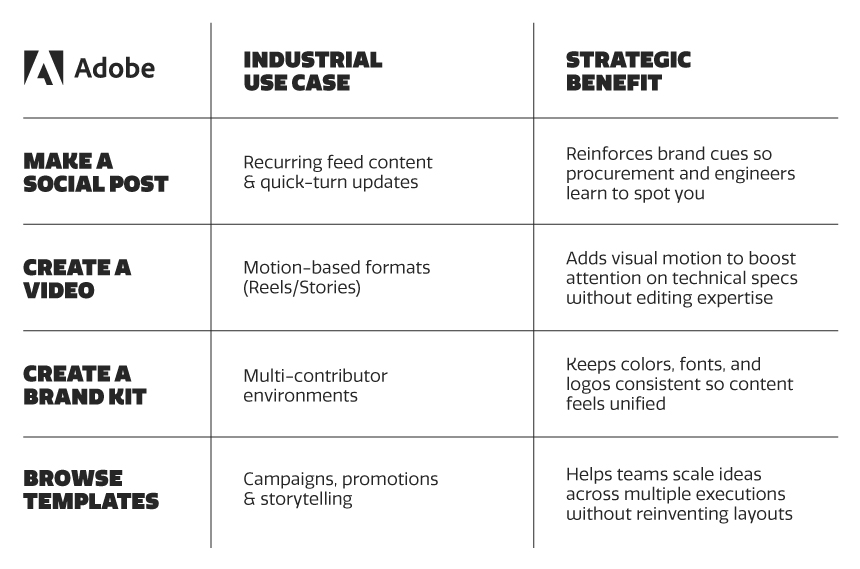
When Tools Become Infrastructure
Most businesses treat creative tools as mere utilities. Brands that successfully scale recognition treat them as infrastructure.
Templates, brand kits, and reusable components are designed to reduce decision fatigue for your team. This creates a positive feedback loop: execution becomes easier, experimentation becomes cheaper, and market differentiation becomes faster.
This is the real competitive advantage of consistency. It stops being a "design problem" and becomes an operational one. Once this infrastructure is installed, your team can focus on high-level storytelling rather than scrambling to rebuild the visual language from scratch every Monday morning.
THE ROI OF FAMILIARITY
The best social strategies aren’t necessarily the most "creative"—they are the most consistent.
When your brand becomes recognizable, audiences infer trust more quickly and absorb complex information more easily. In the B2B space, familiarity isn't a shortcut to persuasion, but it is often a prerequisite for the sale.
You don’t need more posts. You need more recognizable ones.
Systems and templates make that possible without bloating your headcount. Keep the message steady, keep the visuals coherent, and let familiarity compound over time.