Re-Positioning Without Re-Inventing:
How to Modernize Your Visual Identity Without Losing Your Heritage
The Power—and Risk—of a Legacy Brand
For manufacturers and B2B companies, legacy is a competitive advantage. But it can also become a liability.
If your company has been around for 20, 30, 50+ years, you’ve already created lasting brand equity—the real, measurable value of your company’s reputation. A legacy brand usually means you have a recognizable visual identity, a long-standing reputation, and built-in trust with buyers, partners, and distributors. This kind of credibility can’t be faked. In the industrial world, trust is everything, and legacy brands often start miles ahead of newer competitors because of it.
But the perception of credibility and trustworthiness can erode over time. Yes, legacy gives you credibility, but it does not guarantee continued relevance. Markets evolve. Buyers evolve. Technology evolves. Even the expectations of your workforce evolve. The engineers and procurement managers of today research differently, compare differently, and evaluate brands differently than they did 20 years ago.
Often, legacy brands' identities haven’t kept pace with the market. And in a competitive landscape, perceptions matter more than most industrial leaders want to admit.
Balancing Preservation & Progress
The real challenge of refreshing a legacy brand is finding the right balance. You don’t want to throw away decades of hard-earned equity. You don’t want customers to think ownership has changed hands. You don’t want to disrupt trust.
But you also can’t afford to look like you’re stuck decades in the past.
The strongest brands understand that stability and innovation are not opposites. They work together synergistically. Brands perform best when they have a solid foundation and built-in flexibility, which allows them to adapt during market shifts, acquisitions, operational changes, or product expansions without losing who they are. It’s all about evolution, not reinvention. That’s the goal of a brand refresh.
Rebrand vs. Refresh: Understanding the Difference
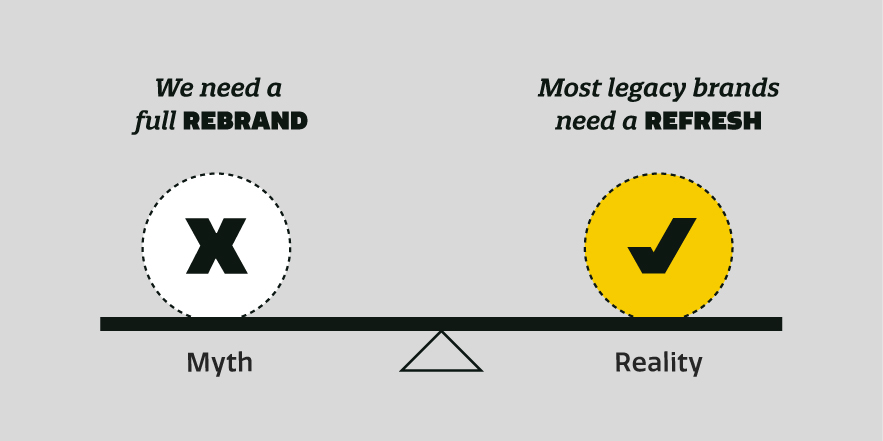
The Myth: We Need a Full Rebrand
Many established companies assume that updating their brand means a complete overhaul. New name. New logo. New messaging. New everything. For a lot of legacy manufacturers, the word “rebrand” alone is enough to shut the whole idea down.
We get it. A rebrand is a big move. And most legacy manufacturers don’t actually need it.
In fact, unless you’re intentionally reinventing the business, hitting the reset button can do more harm than good. You don’t want to risk confusing loyal customers and diluting decades of equity.
The Reality: Most Legacy Brands Need a Refresh
Luckily, you probably don’t need to start over. You just need to evolve.
A brand refresh is more subtle and more strategic for legacy businesses. It focuses on refining and modernizing the elements of your brand without stripping away the core identity that made you successful in the first place.
A brand refresh could mean:
- Polishing and simplifying your logo—not replacing it
- Updating typography and color palettes
- Clarifying messaging
- Creating a more cohesive visual system
- Aligning materials with today’s market expectations
Essentially, a brand refresh is about breathing new life into your brand without changing who you are. A refresh just allows your brand presentation to catch up to the quality of your work.

When a Brand Refresh Makes Sense
A refresh is the right move when:
- Your overall strategy is still aligned with your audience
- Your reputation in the market is strong
- Your products and services are competitive
- Your visual identity feels outdated or inconsistent
- Your website, sales materials, and social presence don’t feel cohesive
In other words, the foundation is solid, but the house could use some updates.
An added benefit of a brand refresh is that it creates new momentum. It gives you a reason to talk about your company’s legacy again. To reintroduce yourself to the market. To remind buyers why you’ve been trusted for decades. Too often, a company’s legacy is tucked away on the About page, like a trophy in a dusty case. When done right, a refresh doesn’t erase your legacy—it spotlights it.

Still Not Sure If You Need a Brand Refresh?
Think of this as a diagnostic checklist. If you’re nodding along to more than one or two of these, that’s your sign that it’s time to consider a refresh.
Your brand feels stale:
If your visual identity hasn’t evolved in decades, chances are it feels a bit dated. Illegible typography. Color palettes that scream early 2000s. A logo that feels nostalgic (but not in a cool, retro way). Your business has evolved, so why shouldn’t your brand?
Your website is losing you customers:
This one is big. We see this constantly with OEMs and B2B manufacturers. If your site hasn’t been updated in years, feels clunky to navigate, or makes it hard to find information, buyers will leave. Not because what you’re selling isn’t good, but because the experience you’re offering potential buyers isn’t.
Today’s buyers are researching long before they ever talk to a sales rep. If they can’t quickly understand what you do, who you serve, and why you’re different, they’ll click over to a competitor who makes it easier. Your website is often your first impression. That’s why in today’s market, a professional, user-friendly website is non-negotiable.
Your brand feels like a patchwork quilt:
Consistency builds trust. But often, legacy brands slowly lose consistency over time. A new marketing manager here. A freelancer there. A sales deck created in a rush. Before long, you’ve got mismatched sales materials, inconsistent social graphics, different logo versions floating around, and no clear guidelines holding it all together.
Branding often isn’t the top priority in industrial businesses, but when your brand starts to feel pieced together, it creates friction, and friction erodes credibility. If your brand experience changes depending on which touchpoint someone interacts with, that’s a red flag.
New competitors are outshining you:
New companies in your market tend to look sharp, modern, and tech-forward. Clean websites. Polished messaging. Strong visual systems. Even if your capabilities are stronger, your brand can start to look outdated by comparison. Perception matters. When competitors look more modern, buyers subconsciously associate them with innovation—whether that’s true or not.
You’re stuck in the price trap:
If you can’t define your value beyond price, then that’s what buyers will default to. When there’s no visible differentiation, then procurement will do what they’re trained to do: compare numbers.
If your brand doesn’t showcase how you’re different, the cost becomes the only obvious variable, and you’ll lose the sale before the conversation even begins. A strong brand positions you beyond price. A weak one forces you to compete on it.
You’ve expanded products & services:
It’s common for companies to add new product lines, new services, new capabilities, and even branch into new markets. But you’re setting yourself up for failure if the brand doesn’t keep up. If your brand was established decades ago, but you offer far more today, then there will be a disconnect. A refresh ensures your identity reflects who you are now, not just who you were.
You’re struggling with recruitment & retention:
If you’re having difficulty attracting qualified candidates or noticing high turnover, it’s time to turn your brand inward. Branding isn’t just for buyers. It’s for employees and future employees.
Job seekers are evaluating your website, your social media, your messaging, and your culture long before they apply. If they can’t see clearly who you are as an employer, what you value, what it feels like to work there, they move on. That’s why your internal brand strategy matters. Your work culture should be visible and tangible. Employees should experience consistency and authenticity in every interaction. When people feel connected to the brand and aligned with its values, retention and recruitment improve.

How to Launch Your Refreshed Brand
Once your brand has been refined, what happens next?
For legacy businesses, a dramatic “big reveal” usually isn’t the best move. Unlike consumer brands that thrive on splashy campaigns, industrial companies operate on trust and stability. A sudden shift can leave customers wondering if something has fundamentally changed. That’s why a slower, more intentional rollout is often the smarter approach.
A phased launch allows buyers to gradually adjust to the updated look and feel. They begin to associate the refreshed identity with the same reliability and performance they already trust. The brand evolves in their minds without disrupting confidence.
A smart rollout also prioritizes touchpoints that your audience interacts with regularly. Start with high-visibility assets like your website, trade show displays, sales decks, spec sheets, and vehicle graphics.

Brand Refresh in Action: Quill Case Studies
McNeilus
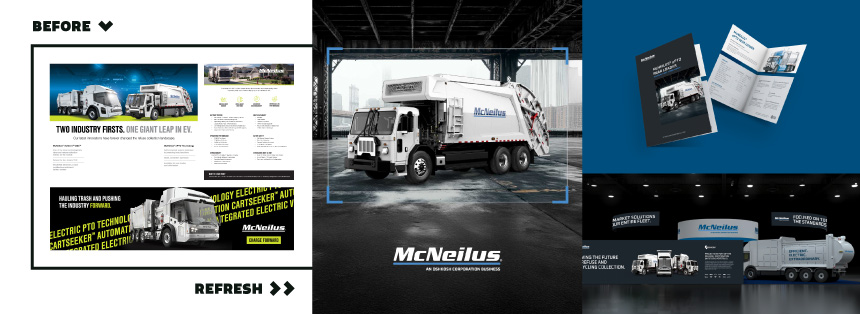
For more than 50 years, McNeilus has been a leader in refuse vehicle manufacturing. Their reputation was built on toughness, reliability, and durability—the kind of brand equity you can’t manufacture overnight (see what we did there?).
But the market was evolving. Technology was becoming more integrated. Data and innovation were reshaping the waste industry. McNeilus needed to shift perception from being seen solely as a rugged equipment manufacturer to being recognized as a visionary technology partner, without losing the trust that years of service have built.
Our refresh approach: We refined the visual identity to elevate the overall brand presence while preserving its recognizable strength. The system balanced high-tech sophistication with a human touch. Typography, color usage, and layout systems were sharpened to reflect precision and forward-thinking engineering, while still honoring the bold, durable DNA of the brand.
Oshkosh Defense
Oshkosh Defense is an established tactical vehicle manufacturer with decades of brand equity rooted in strength, reliability, and service to defense operations. As innovation accelerated within the defense space, they recognized the need to modernize their design language and messaging to better communicate their role as a leader in advanced systems and cutting-edge technologies.
Our refresh approach: We evolved the design language to feel sharper, more modern, and more technology-forward, without stripping away the brand’s core pillars. Strategic messaging updates clarified their advanced capabilities and future-facing position. The visual system was refined to create cohesion and impact across platforms while preserving the authority the brand had long established.

Unified Flex
Unified Flex had built a strong reputation for producing high-quality Form Fill & Seal machines and flexible packaging materials. Their name and logo carried valuable equity, but the supporting brand system lacked cohesion, clarity, and depth. As they prepared to expand marketing efforts and update their digital presence, it became clear that the identity needed to catch up with the company’s growth.
Our refresh approach: We developed a strategic brand foundation centered around collaboration, simplicity, and industry expertise. Messaging pillars were clarified and refined to create a confident, knowledgeable voice. The visual identity system was elevated with stronger typography, cleaner layouts, and a cohesive design language that aligned across all touchpoints.

How Quill can help you with a stress-free refresh of your brand
Your brand is one of the most valuable assets your company owns. But deploying a brand refresh is probably not the highest thing on your operations checklist. You’ve got production targets, supply chain challenges, hiring needs, and growth initiatives to manage.
This is where partnering with an experienced brand agency makes a real difference.
At Quill, we don’t just hand over a brand guide and wish you luck. We help you stick the landing. That means strategic rollout planning, real-world applications built from day one, and done-for-you execution that ensures consistency across your most important materials. With a well-strategized refresh, you can protect your heritage while positioning your company for the next decade of growth.
You stay focused on running the business, while we make sure your brand is working for you.
Ready to refresh? Connect with one of our creative branding experts today.


