
The Problem with “Eco-Friendly” Branding in Manufacturing
(and What to Do Instead)
For manufacturers, a genuine commitment to environmental responsibility is a win-win. It strengthens customer loyalty, appeals to investors, sets your company apart in an increasingly competitive market, and contributes to efforts to protect our planet (so actually a win-win-win-win!). Simply put, sustainability isn’t just good for the planet—it’s good for business.
The keyword here, of course, is genuine.
Today’s customers, employees, and business partners are incredibly savvy when it comes to sustainability claims. They want to support companies that are making meaningful changes, not simply swapping their logo to green every April for Earth Day. In fact, 9 in 10 consumers worldwide believe businesses should use their resources to improve society and the environment, and 82% believe companies should have sustainability guidelines and practices in place to demonstrate they care about more than just profit. Manufacturers that embrace sustainability authentically have an opportunity to build deeper trust with every audience they serve.
You Can’t Design Brand Identity Around Empty Claims
Before you start adjusting color palettes and refreshing your website to appear eco-friendly, sustainability has to become part of your company's DNA, regardless of whether it's a cornerstone of your brand or just a piece of the pie. Before you create messaging around your environmental initiatives, make sure there’s substance behind every claim. Great branding doesn’t replace proof. It should highlight it.
The companies that communicate sustainability most effectively are the ones that have already woven it into their daily operations and decision-making. Sustainability becomes a guiding principle that influences everything from strategic investments and operational improvements to supplier relationships and long-term planning. It gives purpose to decisions that may require additional time or upfront cost because they're rooted in a larger commitment to responsible growth.
That’s why, if you’re going to claim that your company has sustainable practices, you have to walk the walk first. That means committing to reducing waste throughout the manufacturing process, improving energy efficiency, replacing disposable supplies with reusable alternatives, evaluating purchasing decisions through the lens of environmental impact, and more, depending on your industry. If sustainability is truly part of your brand, it should influence decisions at every level of the organization—not just the marketing department.

Earn Credibility Before You Ask for Trust
Anyone can add the words “eco-friendly” or “focused on sustainability” to a website. Earning third-party validation is what adds credibility to the claim. Certifications, sustainability partnerships, and transparent reporting demonstrate your company is willing to put its claims under the microscope, which is exactly the kind of accountability today’s customers are looking for.
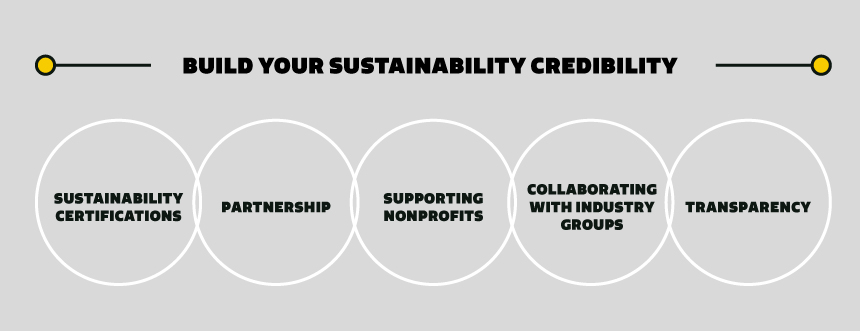
There are a number of well-respected sustainability certifications worth exploring, and we encourage you to look into both general certifications and niche certifications for your industry. Some of the heavy hitters include:
- ISO 14001: An internationally recognized standard for Environmental Management System (EMS). It provides a framework for improving resource management, reducing waste, and lowering greenhouse gas emissions.
- B Corp Certification: Recognizes companies that meet rigorous standards for environmental and social performance, transparency, and accountability. It signals that your business considers its impact on employees, communities, customers, and the planet.
- ENERGY STAR® Certification: Demonstrates that a manufacturing facility or product meets energy efficiency standards established by the U.S. Environmental Protection Agency, helping reduce both operating costs and environmental impact.
- Forest Stewardship Council (FSC) Certification: Particularly valuable for manufacturers that produce or use wood, paper, or other forest products. It verifies responsible sourcing and sustainable forestry practices throughout the supply chain.
- Global Reporting Initiative (GRI): These standards help organizations produce comprehensive sustainability reports that communicate environmental, social, and governance (ESG) performance with consistency and transparency.
Of course, certifications aren't the only way to build credibility. Many manufacturers strengthen their sustainability story by partnering with organizations that align with their mission, supporting environmental nonprofits, participating in regional conservation initiatives, or collaborating with industry groups focused on responsible manufacturing. The key is choosing partnerships that make sense for your business rather than chasing recognition for its own sake.
Finally, don't overlook the value of transparency. Publishing ESG reports, annual sustainability updates, or corporate social responsibility (CSR) initiatives gives stakeholders a window into your progress. It shows that sustainability is an ongoing commitment that you are measuring, evaluating, and continually improving, rather than just a box you check once.
Build Sustainability Into Your Company Culture
Your employees are one of your most important brand ambassadors. If sustainability is truly a pillar of your brand, they shouldn't only hear about it during onboarding or see it mentioned on the company website.
The strongest sustainability brands build a company culture that reinforces their environmental values at every level. When employees understand why sustainability matters and are given opportunities to participate in those efforts, they are more likely to embrace the mission and advocate for the brand.
Consider incorporating sustainability into your company culture through initiatives like:
- Organizing volunteer days with local environmental organizations
- Hosting park, beach, or community cleanup events
- Offering paid volunteer hours so employees can support causes that align with sustainability efforts and their own interests
- Providing internal education on environmental best practices that they can bring home
- Being straightforward in communicating company sustainability goals and progress
- Partnering with nonprofits or community organizations that align with your environmental mission
These initiatives are more than just good PR. Instead of sustainability being another corporate buzzword, it becomes something your team actively participates in and can feel good about. This internal alignment also creates stronger external branding.
Prove It With Transparency
Once sustainability efforts are happening inside the organization, the next step is making them visible in a clear, honest way. Stakeholders want evidence, and providing the evidence behind the good intentions builds trust and loyalty
Consumer skepticism around sustainability is high, and for good reason. Surveys consistently show that:
- 76% of consumers question the credibility of environmental claims
- Two-thirds of people globally doubt that companies are genuinely committed to sustainability
- 53% of environmental claims are misleading or vague
- 40% have no supporting evidence at all
That level of doubt means brands need to show their work.
There are several effective ways to communicate progress in a way that feels credible rather than performative:
- Publishing sustainability reports that outline goals, challenges, and progress
- Developing case studies that highlight specific initiatives and outcomes
- Sharing real data tied to energy use, waste reduction, and emissions
- Setting measurable sustainability goals with clear timelines
- Providing annual or quarterly progress updates so audiences can track improvement over time
- Highlighting vendor partnerships that support responsible sourcing and production
- Documenting process improvements that reduce environmental impact across operations
Each of these elements helps translate sustainability from an abstract claim into something tangible. And just as importantly, don't bury the proof. Certifications, third-party validations, and ESG reporting should be easy to find—not tucked away in a PDF or hidden deep within your website. Display them prominently across digital platforms, sales materials, and brand touchpoints so they actively reinforce your credibility.

Now Let’s Talk Branding
Once you’ve embedded sustainability efforts internally, it’s time to communicate externally. So how do you communicate these efforts in a way that feels credible and aligned with your brand identity? The answer is clear messaging and intentional visual design.

Greenwashing
First things first—beware greenwashing.
Greenwashing is the practice of making a company or product appear more environmentally friendly than it actually is. Sometimes it’s intentional, sometimes it’s just overly enthusiastic marketing, but either way, it undermines trust. And in a world where audiences are already skeptical, it can do real damage to your reputation. Consumers have seen enough vague “eco-friendly” claims with nothing to back them up. Your goal isn’t just to sound sustainable. It’s to be sustainable.
Avoid the clichés
When companies start communicating sustainability, there’s often a predictable visual instinct: green color palettes, leafy textures, trees, and heavy earth-tone usage.
Of course, there’s nothing inherently wrong with green or earth tones. They can absolutely play a role in a brand system. The issue arises when they become the entire system without actually aligning with the established brand. Some of the most effective sustainability-focused brands don’t look “eco” in the traditional sense at all. Instead, they feel modern and aligned with innovation and progress, and integrated into the brand cohesively.
Rather than relying on symbolic visuals, think in terms of systems:
- Clean, structured typography that communicates with clarity
- Layouts that reduce visual clutter and feel more intentional
- Print materials designed with minimal waste and thoughtful production choices
- Photography that shows real operations, real people, and real impact (not just stock imagery of babbling brooks)
- Data visualization that makes environmental progress easily digestible
- Honest, straightforward messaging that avoids exaggeration or vague claims
- A modern design language that reflects innovation, efficiency, and future-thinking
Case Study: Great Northern Brand Refresh
Great Northern Corporation, a leading developer and manufacturer of packaging, in-store displays, shipping, merchandising, and product distribution solutions across industrial, commercial, and retail markets, partnered with Quill to evolve its brand system with a renewed focus on sustainability and social responsibility. As a multi-brand parent organization, Great Northern needed a way to elevate the visibility of its environmental commitments while maintaining cohesion across a diverse portfolio of sub-brands. The challenge wasn’t simply to refresh the identity, but to thoughtfully integrate sustainability messaging into a system that could flex across multiple audiences, products, and use cases without losing the strength of the core corporate brand.
Quill worked on updating visual elements like iconography, typography, imagery, and color palette that reinforced the brand’s established visual language while highlighting their sustainability mission.
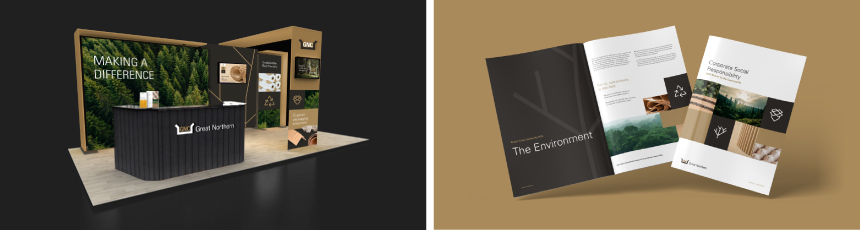
The result is a unified visual system that balances consistency with adaptability, which allows each brand within the Great Northern family to express its core purpose while still clearly belonging to a larger, values-driven organization. This design system ensures that sustainability is not treated as an isolated message, but as an integrated part of how Great Northern communicates across every touchpoint.

Building Brands That Stand for Something
Sustainability is no longer an optional narrative element, especially in the manufacturing industry. It’s a defining part of how modern manufacturers are evaluated and chosen by potential vendors and stakeholders. The strongest brands embed sustainability into their culture, processes, and decision-making and use an intentionally designed brand identity to make that work visible.
Quill helps manufacturers bridge that gap between operational reality and outward perception, through tried-and-true branding methods built for clarity, consistency, and long-term scalability.
If your organization is actively investing in sustainability or ready to start translating those efforts into a clearer, more compelling brand story, let’s chat.


